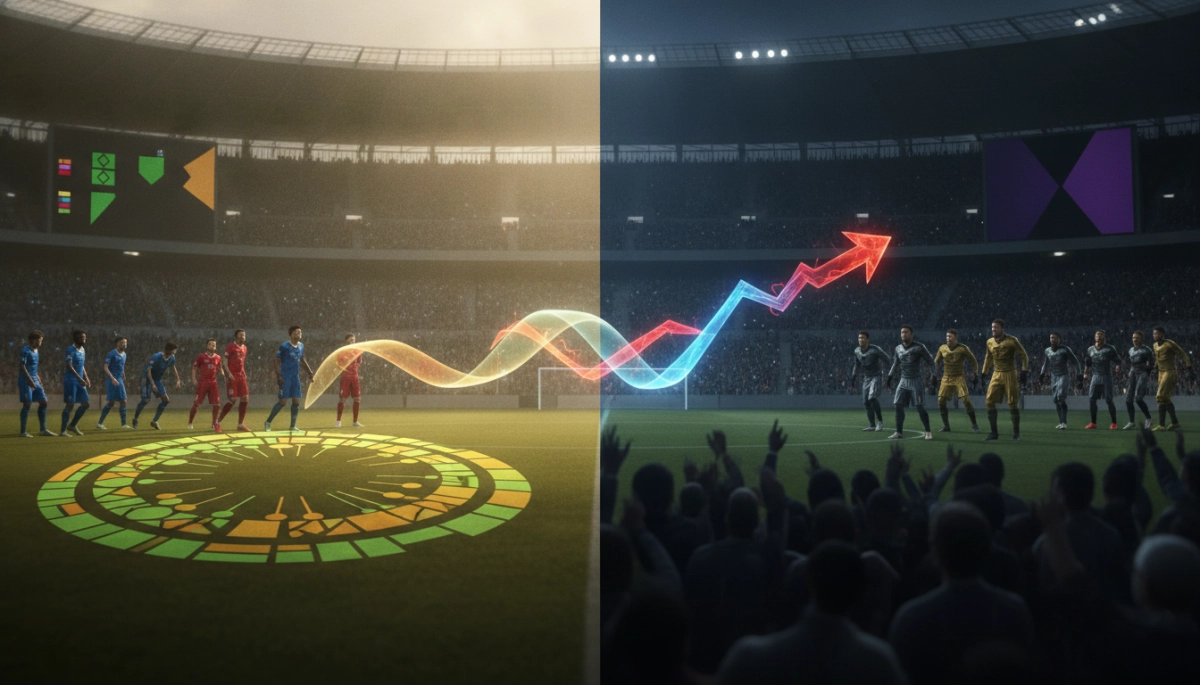
The Competition Hasn’t Changed, But the Betting Environment Has
Most bettors treat the Champions League as a single, unified betting market. They apply the same logic in October’s group stage as they do in March’s knockout rounds, then wonder why results that seemed predictable suddenly aren’t. The tournament’s branding stays consistent, but the competitive dynamics shift dramatically between phases — and those structural differences have direct, measurable consequences for how risk should be priced.
Champions League betting rewards bettors who understand they’re not just handicapping football matches. They’re handicapping matches played under specific competitive conditions that change incentives, lineup selection, and ultimately the probability distributions behind every result. Treating both phases identically is one of the most common — and most expensive — analytical errors a serious bettor can make.
Why the Group Stage Creates a False Sense of Predictability
The group stage gives elite clubs a meaningful safety net. With six matches per group, teams can afford to lose, rotate, and partially disengage without facing elimination. That structural cushion fundamentally changes how clubs approach individual fixtures — and it should change how bettors approach them too.
When top-seeded clubs face minimal qualification pressure in their final group match, the pattern is consistent: squad rotation increases sharply, tactical aggression drops, and the gap between the headline name on the teamsheet and the actual eleven fielded can be enormous. A bettor pricing a match based on squad quality and league form, without accounting for competitive stakes, is modeling a game that won’t be played.
There’s also a subtler distortion at work. Because group stage matches are plentiful and involve recognizable clubs, the market attracts high volume — and high volume compresses odds toward public perception rather than underlying probability. Popular clubs playing at home attract heavy backing regardless of rotation risk, meaning their odds often reflect reputation more than realistic match expectation. That gap between perceived and actual probability is precisely where mispriced value lives.
The inefficiencies tend to cluster around late-group matches where qualification is already settled, fixture congestion periods where rotation is likely but underpriced, and matches involving clubs managing injuries ahead of a heavier domestic schedule.
How Knockout Football Rewires the Risk Calculation
The moment the tournament moves to its knockout phase, the entire competitive logic changes. There is no safety net. Single elimination concentrates a manager’s decision-making around caution, tactical discipline, and away goal protection in a way the group stage never demands. The football itself becomes structurally different — more conservative in first legs, more volatile in second legs when sides are chasing deficits — and the betting markets don’t always price that behavioral shift accurately.
What makes knockout rounds genuinely harder to model isn’t unpredictability in the traditional sense. It’s that the range of plausible outcomes widens, and the factors driving those outcomes shift away from raw quality toward tactical execution, squad depth under pressure, and managerial experience in high-stakes European football. The 2019 semi-final between Barcelona and Liverpool — where a 3-0 first-leg advantage was overturned at Anfield — remains one of the starkest illustrations of how knockout-specific dynamics can invert even the most apparently settled probabilities.
Bettors who haven’t recalibrated their models carry group stage assumptions — that quality wins, that home advantage is substantial, that form holds — into a phase where incentive structures and pressure management are doing far more of the predictive work.
Where the Markets Consistently Misprice Knockout Caution
One of the most reliable structural inefficiencies in Champions League knockout betting stems from how the market handles first-leg matches. Public betting favors goals — over markets are heavily backed, home favorites attract support — but knockout football introduces institutional caution that suppresses scoring in ways group stage data doesn’t capture.
Managers in knockout rounds are not optimizing for the ninety minutes in front of them. They’re optimizing across one hundred and eighty. Protecting a clean sheet on the road becomes a primary objective, and even home sides often resist committing fully forward, unwilling to concede a damaging away goal. The result is a category of matches — particularly first legs between closely matched sides — where the underlying tactical logic points toward low-scoring, cautious football that the market consistently underweights.
Second legs introduce an entirely different distortion. When an away side needs a goal or a home side is protecting a narrow lead, the incentive structures diverge sharply within the same match. One team is pressing, the other is absorbing. That asymmetry creates structured volatility tied to the scoreline and time elapsed — not random unpredictability. Bettors pricing second-leg matches without accounting for the conditional states shaping each team’s approach are ignoring the most important variable on the sheet.
The Role of Squad Depth and How It’s Mispriced Differently Across Phases
Squad depth functions as a different asset depending on which phase you’re analyzing. In the group stage, depth is primarily a rotation resource. Clubs with strong second-choice elevens can manage fixture congestion without meaningful performance loss, creating value in backing sides that rotate predictably. The mispricing is about availability — whether the squad that actually takes the field reflects the club’s perceived quality.
In the knockout rounds, depth shifts from a rotation asset to a resilience asset. It matters most when injuries accumulate across a two-legged tie, when suspensions force unexpected changes between legs, or when a side must chase a deficit and needs bench impact. Clubs that handle these disruptions without visible performance drops are systematically underrated by markets leaning heavily on first-choice lineup quality. Conversely, clubs whose attacking threat concentrates in one or two key figures carry a fragility in knockout football that overall squad ratings don’t fully express.
Reading Managerial Behavior as a Structural Signal
One of the most underused analytical inputs in Champions League betting is managerial pattern recognition — not tactical preference in a general sense, but specific behavioral tendencies experienced managers exhibit when competition stakes change. Some managers have a demonstrable history of prioritizing European positioning over domestic consistency during certain fixture clusters. Others consistently deploy conservative setups in away knockout legs regardless of opponent quality. These are repeatable strategic behaviors tied to specific competitive contexts.
The betting market is reasonably efficient at pricing talent and form. It is considerably less efficient at pricing managerial strategy, partly because managerial decision-making is qualitative and easy to overlook in statistical models. That gap is most pronounced in knockout football, where a manager’s willingness to sit deep and play for a specific scoreline can override team quality as the dominant result-shaping factor.
Tracking these tendencies requires research focused less on expected goals and recent league results, and more on how specific managers have historically approached analogous scenarios. Those behavioral patterns, when consistent and when the market hasn’t fully absorbed them, represent some of the cleaner edges available across the Champions League’s two distinct competitive phases.
Adjusting the Framework Before the Next Phase Begins
The single most practical shift a bettor can make is treating the Champions League as two structurally distinct competitions that happen to share a name and a trophy. In the group stage, the discipline is primarily about identifying when perceived quality is priced without adequate adjustment for competitive motivation and rotation risk. The surface-level odds look reasonable. The underlying competitive logic often isn’t.
In the knockout rounds, the discipline shifts toward structural caution — recognizing that first-leg football is tactically suppressed in ways over markets consistently underweight, that second-leg volatility is conditional rather than random, and that managerial behavior carries more predictive weight than weekly league form. The clubs that win knockout ties are not always those with the highest quality ceiling. They’re often the clubs best equipped to manage a specific competitive format across two legs.
None of this means abandoning quantitative rigor. Expected goals, squad value metrics, and injury data remain relevant. What changes is the interpretive layer — the recognition that the same underlying quality, expressed under different structural conditions, produces meaningfully different probability distributions. A side with an xG profile built on high-tempo pressing looks different in a group stage home match than it does defending a first-leg lead away from home in March. Treating those as equivalent is where the mispricing begins.
For bettors willing to do the structural work, the Champions League remains one of the more interesting markets in European football precisely because the phase transition creates a genuine informational edge. The public follows the competition as a continuous narrative. The market follows it as a continuous product. Neither fully accounts for the moment the format changes — and that gap, consistently exploited over time, is where the analytical advantage is built. For those looking to deepen their understanding of how knockout formats affect betting dynamics, UEFA’s official Champions League coverage provides a useful reference for tracking team news, managerial comments, and pre-match context that informs the structural signals discussed throughout this analysis.
The competition hasn’t changed. The way it should be bet has — from the moment the group stage ends and the knockout rounds begin.