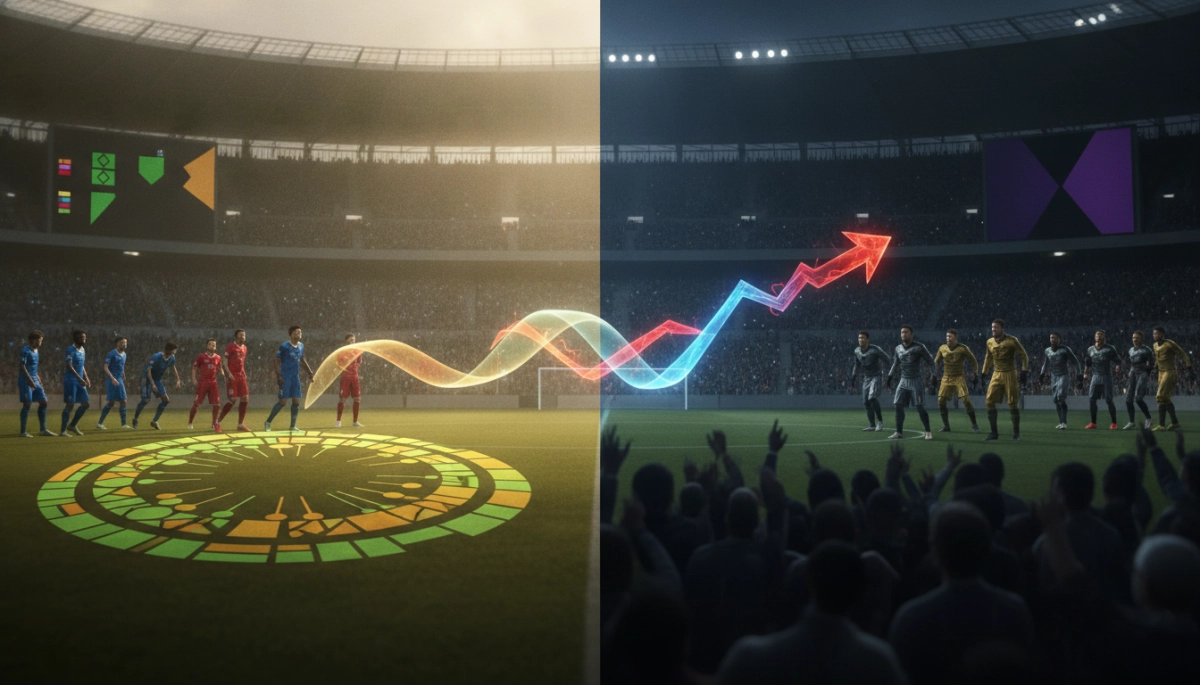
Why the Champions League Is Not One Competition — It’s Several
Most bettors approach the Champions League as a single entity, applying the same analytical framework from the opening matchday in September through to the final in late May. That’s a costly oversimplification. The competition changes structurally, motivationally, and tactically in ways that reshape the betting landscape at each phase.
Understanding those shifts is what separates bettors who treat Champions League fixtures as interchangeable from those who identify genuine edges. The group stage, round of 16, quarter-finals, and semi-finals each carry their own logic, market behaviors, and traps for the unprepared.
The Group Stage: Where Rotation and Context Are Everything
The group stage runs parallel to domestic leagues, and that scheduling pressure is the single most important factor bettors frequently underweight. A club sitting comfortably at the top of their group with qualification already secured has almost no rational incentive to field a full-strength side. Managers treat these fixtures as opportunities to manage squad load — and they do so without much ceremony.
This creates real market distortions. Bookmakers price group stage matches largely on reputation and recent form, meaning a heavily favored side resting seven or eight first-team players can still open as a significant favorite. Bettors who track squad announcements and understand which clubs rotate aggressively — Guardiola’s City sides have historically been among the most systematic — can identify matches where the implied probability doesn’t reflect the team likely to take the field.
Motivation is equally variable. Early matchdays carry more competitive intensity, with clubs still establishing their position. By matchday five and six, a number of fixtures are effectively dead rubbers on one or both sides. These late group stage games are some of the most fertile ground for market inefficiency in all of Champions League betting, precisely because casual volume is high while the underlying competitive context has shifted dramatically.
How Dead Rubbers Distort Market Pricing
Dead rubber group stage matches attract substantial betting volume driven by name recognition rather than situational awareness. A fixture between two historically prominent clubs draws significant action regardless of whether either side has anything meaningful at stake — and that volume suppresses the odds on the more recognizable team, even when their motivation to win is genuinely low.
Across multiple recent group stage cycles, clubs already through to the knockout rounds and playing away on the final matchday have consistently underperformed their pre-match price. This isn’t randomness. It’s a structural pattern rooted in the fact that nothing consequential is riding on the result for those clubs, while opponents may still be fighting for Europa League qualification or to avoid the additional knockout round.
Asymmetric motivation — where one side cares considerably more about the outcome than the other — is one of the most underexploited concepts in football betting. In the Champions League group stage, it surfaces reliably enough to be factored into any serious analytical process. The key is identifying it before the market does, which requires reading beyond the league table and understanding the actual qualification arithmetic for each team.
The Round of 16: Where the Competition Truly Begins
The transition to knockout football triggers an almost categorical shift in how clubs approach fixtures. Once elimination becomes a real and immediate consequence, rotation drops sharply, tactical caution increases, and the margin for error managers accepted in December evaporates entirely. The same coach who rested his first-choice midfield on matchday six will field his strongest available eleven across both legs of the round of 16 without hesitation.
Yet markets don’t always price this correctly. Bookmakers and the betting public anchor heavily on head-to-head reputation and current league form when pricing knockout ties, underweighting the specific context of two-legged football — a genuinely different competitive environment from anything clubs experience domestically.
Two-legged ties introduce strategic calculation that single matches simply don’t contain. The first leg result shapes everything about the second. A narrow away win transforms the return fixture into a fundamentally different game than a comfortable home victory would. Clubs that concede an away goal play the second leg with a psychological weight that influences team selection, pressing intensity, and willingness to accept risk. These behavioral shifts are real and frequently underappreciated by markets still applying static form-based pricing.
How Aggregate Thinking Still Shapes Behavior
While UEFA eliminated the away goals rule in 2021, its influence on coaching behavior has not disappeared. Managers who spent their formative years operating under that rule still instinctively structure their approach around aggregate dynamics. The caution that characterized first-leg away performances under the old rule persists even if the formal incentive structure has changed.
First legs played away from the higher-seeded club tend to remain tighter and lower-scoring than a straightforward assessment of attacking quality might suggest. The favorite, playing away first, often prioritizes defensive solidity over aggressive pursuit of an early aggregate lead. Total goals markets and Asian handicap lines in these fixtures can carry inefficiencies that reflect the market’s failure to account for this persistent tactical conservatism.
Quarter-Finals and Semi-Finals: When Liquidity Distorts Rather Than Clarifies
By the quarter-final stage, the betting market for each fixture becomes significantly more liquid than anything seen earlier. Global attention intensifies, recreational volume rises sharply, and brand recognition draws action from casual bettors following the spectacle rather than the competitive detail.
Counterintuitively, this surge in volume does not improve pricing accuracy. The increased weight of recreational money — disproportionately placed on recognizable names and recent high-profile performances — can push odds on elite clubs to levels that don’t fully account for fatigue, fixture congestion, or the psychological complexity of managing a grueling domestic and European schedule simultaneously.
At this stage, the remaining clubs are close enough in quality that small contextual factors carry outsized significance. Injury to a key player, a manager rotating to protect a booked defender, or the psychological burden of arriving as the overwhelming favorite — these elements can shift outcome probability by several percentage points in ways that name-driven money hasn’t adjusted for.
- Fixture congestion in late March and April means squads arrive at quarter-finals with varying levels of physical depletion — tracking schedule density in the preceding six weeks provides meaningful context.
- Managerial experience in two-legged knockout football varies considerably and influences tactical decision-making in ways that raw team quality metrics don’t capture.
- Stylistic matchups at this stage regularly produce results that defy straightforward hierarchical prediction.
The semi-final environment compounds these dynamics further, adding the psychological weight of a final within reach. Clubs that have historically struggled to convert semi-final appearances into final berths sometimes carry that institutional anxiety into their performance, regardless of what squad quality on paper might suggest.
Betting the Champions League With the Phase in Mind
The analytical thread running through every stage is the same: structural context matters more than reputation, and reputation is precisely what the market prices most heavily. That gap — between what is being priced and what is actually shaping the competitive environment — is where genuine betting value lives.
In the group stage, that gap opens widest around rotation and motivation. A methodical bettor who tracks squad announcements, monitors qualification arithmetic, and identifies asymmetric motivation will find more exploitable situations across those six matchdays than at almost any other point in the European calendar. The challenge is discipline — resisting the pull of big-name fixtures and focusing on the specific dynamics that make a particular match behaviorally unusual.
In the knockout rounds, the edge shifts. Rotation becomes largely irrelevant, replaced by subtler variables: aggregate psychology, tactical conservatism in first legs, historical knockout record, and the physical state of squads navigating a congested late-season schedule. The market becomes sharper in some respects, but the flood of recreational volume at the quarter-final and semi-final stage introduces its own distortions — ones that reward bettors who have done contextual groundwork rather than following the public narrative.
For those serious about developing a more structured approach to European football betting, Football Data provides extensive historical results and odds data that can help identify the kinds of phase-specific patterns discussed throughout this piece.
The Champions League rewards granularity more than most competitions because it presents more structural variation within a single tournament than almost anything else in the football calendar. Treat each phase on its own terms, and the competition stops being one impenetrable market and starts revealing distinct environments — each with its own logic, its own inefficiencies, and its own specific demands on how you think.