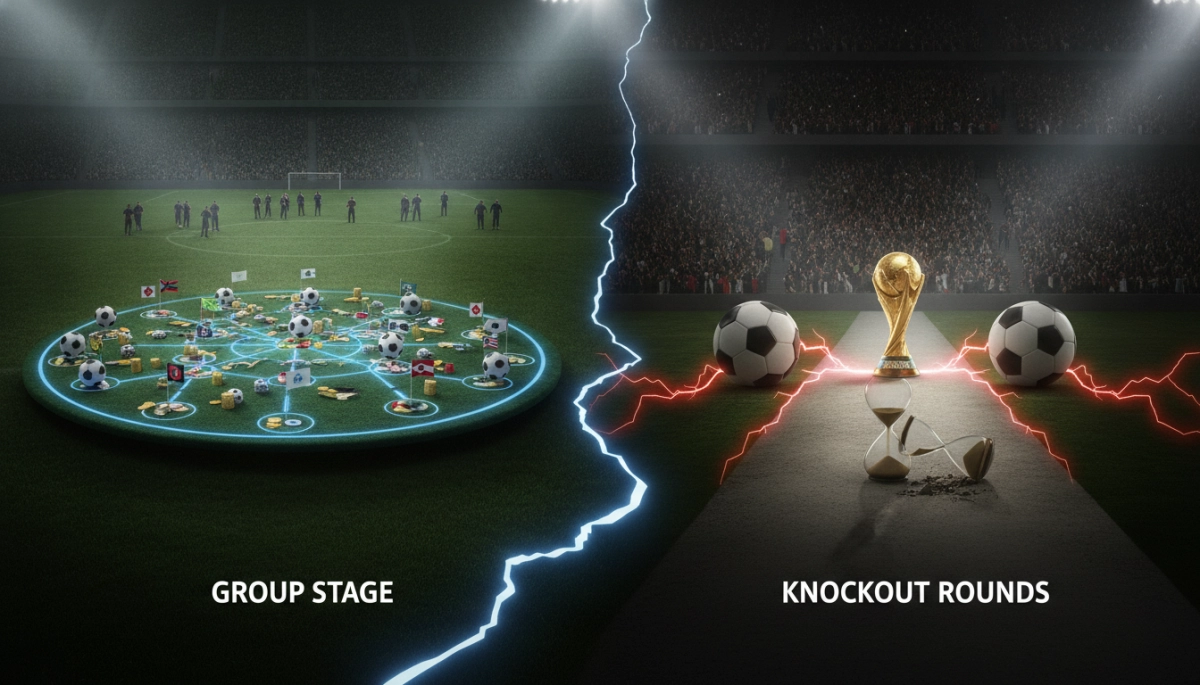
Same Competition, Different Game: Why Champions League Structure Changes Everything
Most bettors approach the Champions League as a single, unified betting market — applying the same logic in September’s group stage openers as they do in March’s last-16 second legs. That’s a costly mistake. The Champions League format shifts fundamentally halfway through, and with it, the motivations, squad decisions, and risk calculations of every club involved change dramatically.
Understanding this structural divide is one of the cleaner edges available in Champions League betting. It doesn’t require insider knowledge or exotic data. It requires recognising that a team’s behaviour in a low-stakes group fixture is genuinely, measurably different from how they operate when one bad result ends their European campaign.
Group Stage Betting: Navigating the Rotation Problem
The group stage runs across six matchdays spread over roughly three months. For clubs expected to progress, many fixtures represent a workload management problem more than a genuine competitive test. When qualification is secured by matchday four or five, matchday six becomes an opportunity for rotation, rest, and experimentation.
This makes publicly available team news far more important than pre-match narrative. Markets price group stage games on overall squad quality, recent form, and historical performance — they’re slower to reflect a coach fielding five or six rotated starters. The headline name stays the same; the actual eleven changes considerably. That gap between perceived quality and actual selection is where the inefficiency lives.
There’s also a motivation asymmetry worth examining. A team already through with nothing to play for faces an opponent fighting for third place and a Europa League playoff spot. The competitive intensity between those clubs is fundamentally unequal — yet markets don’t always account for it fully, particularly when a dominant club’s brand reputation inflates their odds regardless of context.
What Changes the Moment the Knockout Stage Begins
The shift to knockout football is more than a format change — it’s a change in psychology at every level of the club. There is no margin for error. A poor away performance can’t be corrected three weeks later. This forces coaches into conservative tactical decisions, particularly in first legs away from home, where containing the damage often takes clear priority over winning.
Knockout football tends to produce tighter, lower-scoring affairs between evenly matched opponents because both sides are playing with an eye on 180 minutes rather than 90. Historically, the volume of draws and narrow single-goal results in knockout first legs reflects this reality, even when one side is nominally stronger on paper.
The implications for over/under markets, both-teams-to-score lines, and Asian handicaps differ sharply from the group phase. But effective knockout betting goes beyond expecting fewer goals — it involves reading motivation signals, squad fitness cycles, and the psychological weight of elimination in ways the group stage simply doesn’t demand.
First Legs vs. Second Legs: Two Different Betting Problems
Treating knockout ties as a single unit is almost as misleading as equating the group stage with the knockouts. First and second legs operate under different psychological pressures, and markets don’t price these identically every time.
First legs — especially those where the away side is genuinely competitive — are played with significant tactical caution. Coaches talk openly about not conceding away goals, keeping the tie alive, making it a contest heading into the second match. That language translates into actual defensive shape, cautious pressing lines, and an unwillingness to commit forward in transition. The result is measurably more conservative football than the same two teams might produce in a league fixture.
Second legs are the inverse problem. The first-leg scoreline reframes everything. A team trailing by a single goal at home faces urgency that alters their entire structure — they press higher, take more risks, commit more players forward. Meanwhile, the side protecting a lead may drop deep and invite pressure, paradoxically opening space for the team chasing the tie.
The actionable insight isn’t simply that second legs produce more goals — the data doesn’t support that as a blanket rule. It’s that second-leg dynamics depend entirely on context: how large the first-leg deficit is, whether the trailing team has genuine attacking quality, and whether the leading side can absorb pressure without collapse. Reading those variables correctly is more valuable than any generic second-leg assumption.
How Squad Depth Becomes a Pricing Signal in Knockout Rounds
One of the subtler differences in knockout rounds is the role squad depth plays — not as background noise, but as an active variable that moves market value in trackable ways. By the time knockout football arrives, a key injury or suspension carries a weight no group stage absentee can match. Markets, while generally efficient, don’t always recalibrate fast enough when news breaks late in the week.
There are specific positions where mispricing is most likely:
- Central midfield controllers — clubs built around a single deep-lying playmaker are structurally disrupted when that player misses a knockout leg, with effects on possession and tempo that aren’t easily compensated.
- Fullbacks in high-pressing systems — modern fullbacks carry enormous attacking responsibility. Replacing a first-choice option with a reserve can quietly reduce a team’s output by a measurable margin without the change being obvious in headline odds.
- Set-piece specialists — in tight knockout games where dead-ball situations carry outsized importance, losing the primary delivery option has consequences that flat market adjustments rarely capture.
The window between confirmed team news and kickoff is genuinely one of the most productive moments for informed bettors in knockout football. Odds move, but not always proportionally to the actual impact — especially when the absent player is quietly essential rather than publicly celebrated.
Home Advantage and the Distortion of Familiar Metrics
Home advantage in Champions League knockout football is real, but it operates differently from domestic football. The familiarity effect exists, but it’s partially counteracted by the quality compression at this level. Elite away sides are far better equipped, technically and psychologically, to manage hostile environments than mid-table domestic opposition.
The market’s default assumption of home advantage — built largely from domestic data — tends to be slightly overapplied to knockout fixtures involving elite away sides. A seasoned Spanish club playing away in England is not experiencing the same structural disadvantage a Championship side might face on the road. The competence of genuinely elite squads levels the playing field in ways that don’t always appear in odds shaped partly by casual money backing the home side on name recognition alone.
This distortion is most visible where the away side is arguably stronger on quality metrics but home-fixture pricing has pushed them out to an inflated price. Tracking where home-field assumptions have historically overpriced strong away sides in knockout rounds reveals a pattern worth building into a systematic approach — particularly in later rounds where the quality gap between remaining clubs is genuinely narrow.
Building a Phase-Aware Approach That Actually Holds Up
The core argument is straightforward: the Champions League is not a single betting environment. It is at least two distinct ones — and within the knockout phase, it subdivides further depending on which leg you’re analysing, how the aggregate stands, and what each manager’s tactical priorities are. Treating it as a unified market is where most casual bettors leak value they never recover.
A phase-aware approach means asking different questions depending on where in the competition a match sits. During the group stage, the primary question is motivational: who actually needs something from this game, and does the market reflect that asymmetry? The secondary question is selectional: is the known lineup genuinely what the odds were built on, or has rotation quietly eroded the quality being priced?
In the knockout rounds, the questions shift. Motivation is essentially resolved — everyone needs to win over two legs. The productive questions become tactical and contextual: how is this coach likely to approach a first leg away from home? What does a one-goal deficit mean for how the second leg will be structured? Which absences are being underweighted because the player isn’t a household name despite being structurally essential?
These aren’t complicated questions. They are, however, consistently underasked by the recreational volume that shapes the market’s centre of gravity. That’s the real source of the edge — not that markets are naive, but that they’re partly shaped by money that isn’t asking the right questions for the specific phase of football being played.
For anyone looking to sharpen that structural thinking, UEFA’s official Champions League historical archive provides useful context on how the competition’s format has evolved and how different phases have historically played out — grounding worth having before interpreting current market signals.
The Champions League rewards bettors who respect its structure. The format is the edge — if you’re willing to read it carefully enough to use it.